Why Generic AI Video Editors Struggle With BMX Footage
There is a growing market of "AI Video Editors" that promise to take a 4-hour podcast or a Twitch stream and automatically cut it into engaging TikToks and YouTube Shorts. For talking heads, they work brilliantly. They transcribe the audio, look for keywords, crop to the face, and export.
But what happens when you feed one of these tools a 20-minute raw tape of a BMX session? Complete failure.
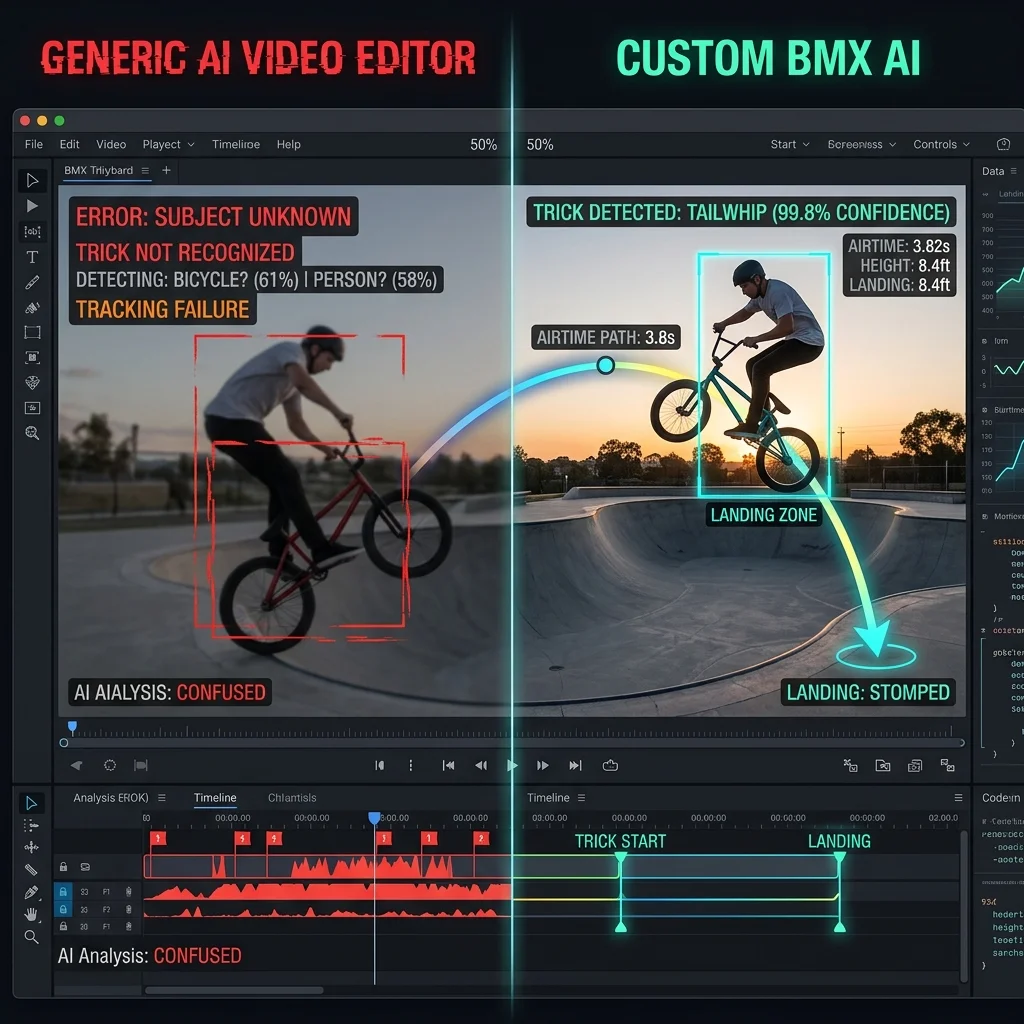
The Keyword Trap
Generic AI editors rely almost entirely on audio transcription. In action sports, nobody is talking during the climax of the clip. If anything, they are silent in concentration.
When a standard AI editor scans a BMX clip, it usually highlights the moments after a trick where the filmer says, "Yeah man, that was sick!" It completely misses the actual 4-second window where the rider approaches, airs, and lands the trick because there is no spoken word to anchor it.
The Auto-Crop Disaster
Even if a generic AI manages to find a clip with high audio peaks (the sound of the bike hitting the ground), it destroys the visual composition during export.
Most action sports are filmed with a fisheye or ultra-wide lens to capture both the rider and the obstacle (the rail, the ramp, the gap). When generic AI editors try to convert a 16:9 clip into a 9:16 vertical short, they use facial recognition to keep the subject centered.
In BMX, a rider spinning a 360 moves drastically across the frame. When the AI aggressively tracks their face, the obstacle moves wildly out of frame. The viewer loses all context of what the rider is jumping over.
Building Domain-Specific AI
The failure of generic tools is why I had to build a custom pipeline (detailed in my previous post).
A BMX AI needs to understand:
- The Audio Signature: The click of a freewheel, the pop of the tires, and the metallic clang of a grind are more important than human speech.
- The Framing Hierarchy: The center of the trick is often between the rider and the obstacle. You don't track the rider's face; you track the bounding box that encompasses both the rider and the landing ramp.
This is a recurring lesson in AI engineering: generalized models are incredible baselines, but domain-specific problems require domain-specific orchestration.