Building an Agent-Controlled Non-Destructive Image Editor
When we talk about "AI Image Editing," we usually mean generative fill. You highlight a section of a photo, type a prompt, and the AI replaces the pixels. While powerful, this is entirely destructive. The original pixels are gone, and you cannot mathematically reverse the operation.
Professional creative workflows (like Photoshop or Nuke) rely on non-destructive editing. You stack adjustment layers, vector masks, and blending modes on top of an original plate.
If an AI agent is going to do professional creative work, it needs access to a non-destructive pipeline. So, I built one.
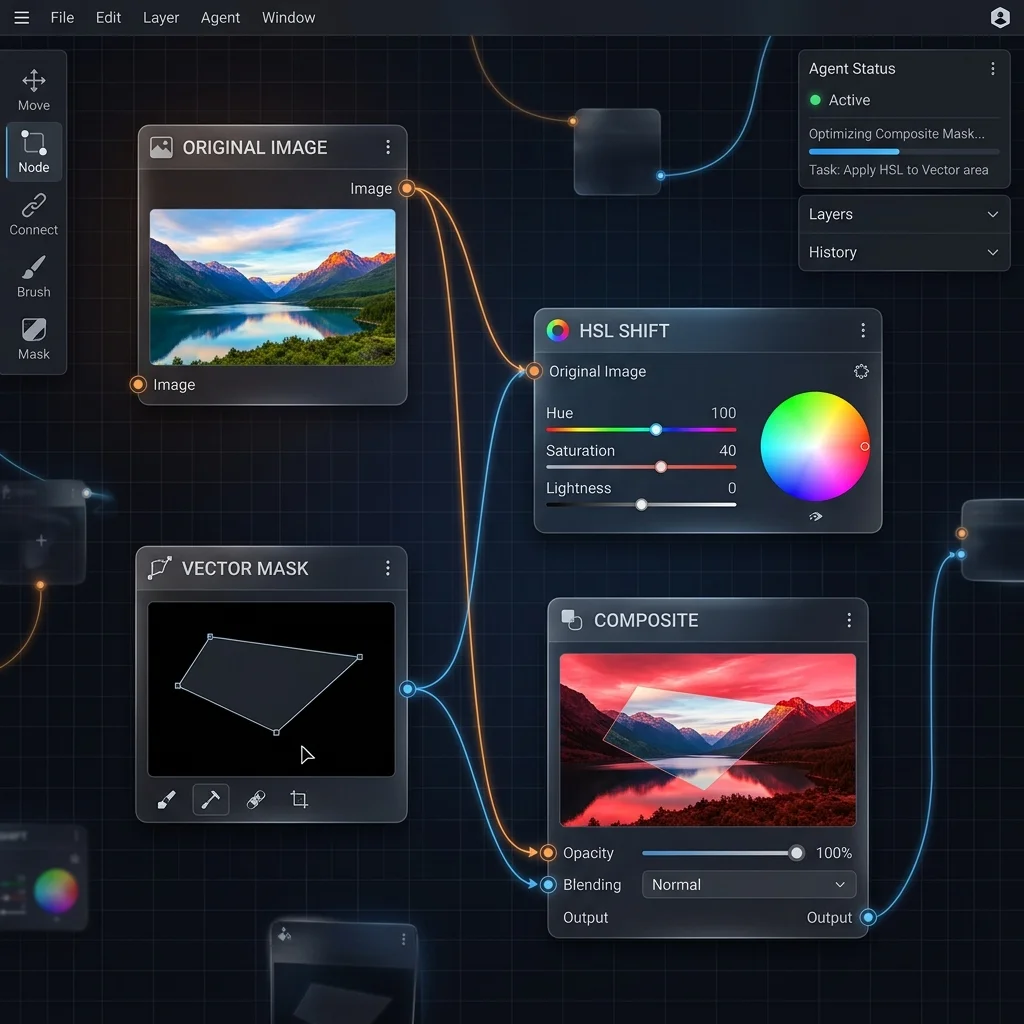
The Node-Based Architecture
Instead of having the AI directly manipulate pixel matrices using Python's PIL (which often leads to memory issues and irreversible mistakes), I built a node-based architecture.
When the agent wants to color-correct a photo, it doesn't edit the image. It generates a JSON payload representing a node graph:
{
  "nodes": [
    {
      "id": "source_1",
      "type": "image_input",
      "path": "/assets/raw/bmx_jump.jpg"
    },
    {
      "id": "hsl_1",
      "type": "hsl_shift",
      "inputs": ["source_1"],
      "params": { "hue": 0, "saturation": 1.2, "lightness": 0.95 }
    },
    {
      "id": "output_1",
      "type": "render_target",
      "inputs": ["hsl_1"],
      "format": "webp"
    }
  ]
}
The Execution Engine
Once the agent constructs this JSON graph, it passes it to the MCP server. The server runs a headless execution engine (built on top of high-performance C++ imaging libraries) that evaluates the node graph and renders the final output.
If the client reviews the image and says, "The sky is too saturated," the AI doesn't need to start from scratch. It retrieves the existing node graph, targets the hsl_1 node, reduces the saturation parameter to 1.05, and triggers a re-render.
Why This Matters
By forcing the AI to work through a node-based schema:
- It prevents hallucination: The agent can only use predefined adjustment nodes (Curves, HSL, Levels, Masks).
- It preserves the source: The original asset is never touched.
- It creates an audit trail: You can read the JSON file and see exactly what mathematical operations the AI performed on the image.
Generative AI is a fantastic brainstorming tool, but deterministic, node-based architectures are what turn AI into a reliable production assistant.