How I Built an AI System to Search Thousands of BMX Clips
If you've ever tried to edit an action sports video, you know the hardest part isn't the editing itself—it's the logging. Going through thousands of clips to find the three angles where a rider actually landed a trick cleanly takes hours.
Generic AI video editors are terrible at this. They look for talking heads or high-contrast scene changes. They don't know the difference between a tailwhip and a barspin, let alone the difference between a landed trick and a painful bail.
To solve this, I built a custom AI pipeline capable of searching, tagging, and categorizing thousands of raw BMX clips automatically.
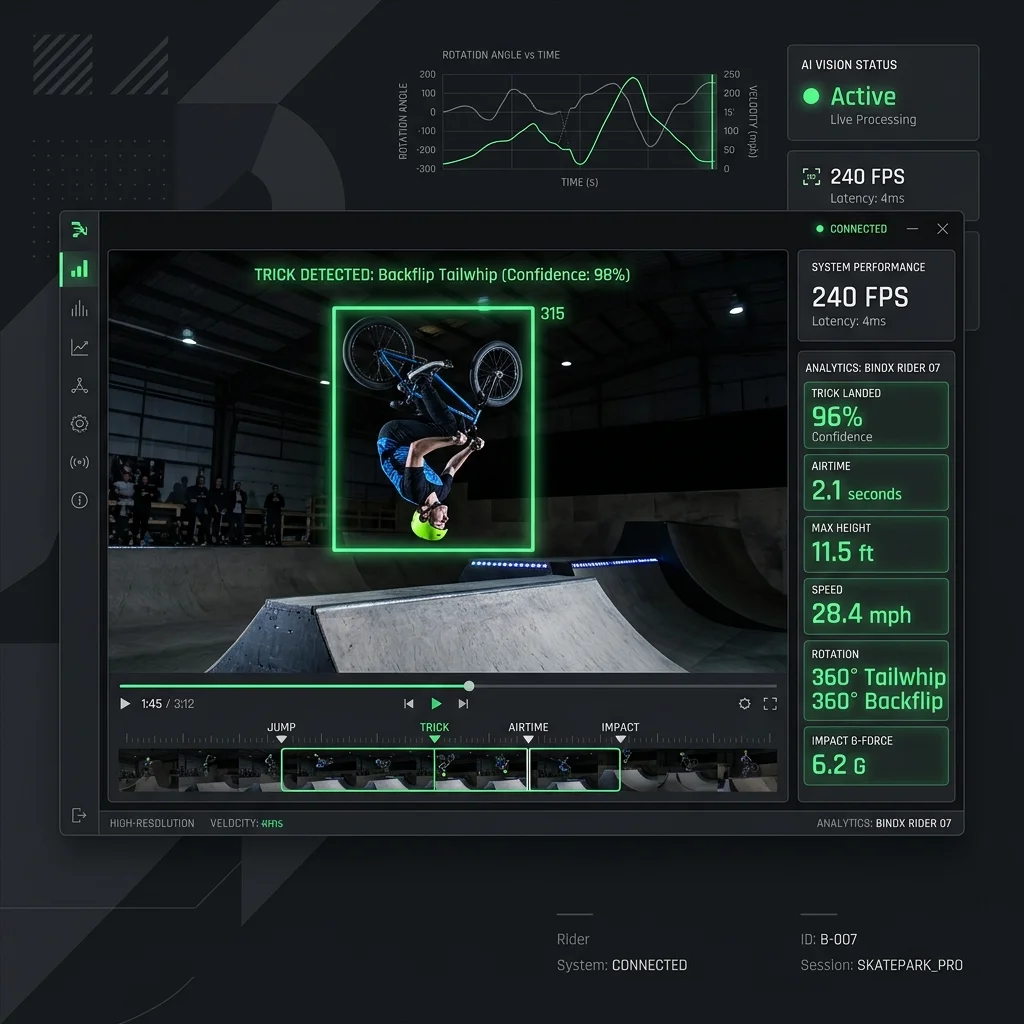
The Problem: 3,355 Raw Clips
When I started this project, I had an archive of over 3,000 raw BMX clips. My goal was to build a system that could answer queries like:
- "Find all clips of a 360 over a dirt jump, landed cleanly."
- "Find all bails on handrails."
Doing this required chaining together three distinct technologies: Computer Vision (YOLO), Audio Peak Analysis, and a Large Language Model for reasoning.
Step 1: Object and Scene Detection (YOLO)
The first pass of the pipeline runs a custom-trained YOLO (You Only Look Once) model. Standard object detection can find a "bicycle," but I needed it to find "BMX bike," "rider in air," "grind rail," and "dirt jump."
I fine-tuned a YOLOv8 model on a few hundred frames of BMX footage. As it processes a video, it logs the presence of these elements frame-by-frame into a JSON file.
Step 2: Finding the Action via Audio
Action sports have a very distinct audio signature. The sound of a pedal click, the snap of a bunnyhop, the loud clank of pegs on a rail, and the thud of landing (or crashing).
I wrote a C++ utility using FFmpeg that scans the audio track of each clip and logs the exact timestamp of peak audio events.
// Pseudocode for audio peak detection
std::vector<int> FindAudioPeaks(const std::string& filepath, double threshold) {
    // Decode audio stream
    // Calculate RMS volume per frame
    // If volume > threshold, log timestamp
    return peak_timestamps;
}
Step 3: LLM Reasoning and Tagging
This is where the magic happens. We now have a JSON file containing:
- When a rider and a rail were on screen.
- When the loudest impacts happened.
I feed this telemetry data into a local LLM, instructing it to act as an action sports judge. The prompt looks something like this:
"You are analyzing telemetry from a BMX clip. The rider approaches a rail at 00:03. A loud impact occurs at 00:04 (pegs hitting rail). Another impact occurs at 00:06 (landing). The rider remains on the bike and exits the frame at 00:08. Did they land the trick or bail?"
Because the telemetry clearly shows the rider continuing after the second impact, the LLM confidently tags it as [Status: Landed]. If the audio showed a massive impact followed by the bike and rider separating in the YOLO bounding boxes, it would tag it as [Status: Bail].
The Search Interface
All of this data is stored in a local SQLite database, indexed using vector embeddings for semantic search. Now, when I type "clean rail grinds," the system doesn't just guess—it queries the telemetry.
Domain knowledge matters. You can't just throw raw footage at a generic model and expect it to understand the nuances of a sport. But when you combine deterministic analysis (audio, bounding boxes) with agentic reasoning, you can index a lifetime of footage in an afternoon.