Architecture Engineering Technology vs an Architecture Degree
When people hear you work in architecture, they assume you spend your days sketching parti diagrams on trace paper. But the reality of modern building design is far more technical.
While a traditional Architecture degree focuses heavily on theory, history, and spatial form, a degree in Architecture Engineering Technology (AET) focuses on execution—how the building actually goes together, and the systems required to draft, model, and document it.
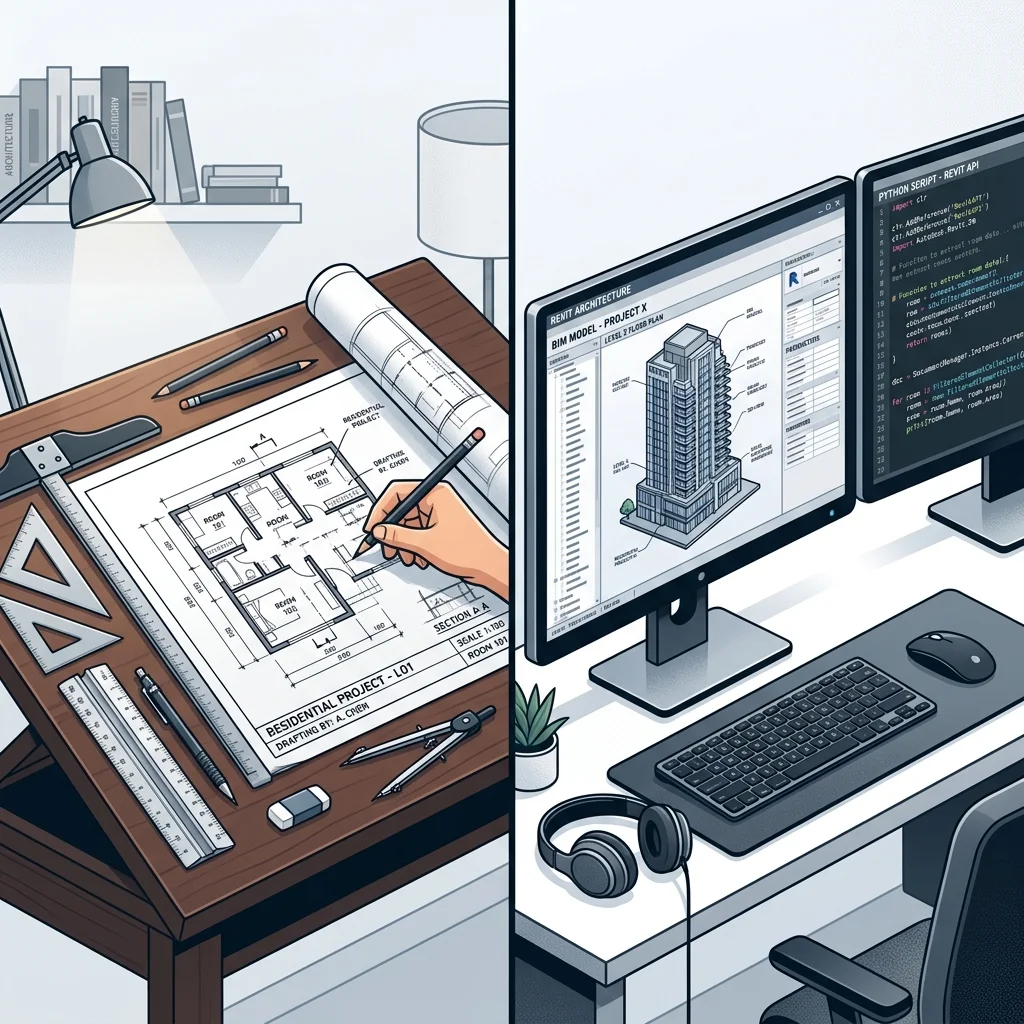
The Theory vs. Execution Divide
In a standard B.Arch program, the critique centers on concepts. How does this facade respond to the urban context? What is the narrative of the circulation?
In an AET program, the critique centers on constructability. How are you waterproofing that parapet? Where is the HVAC return? How does the structural grid align with the basement foundation?
This fundamental difference creates a distinct type of professional. An AET graduate is often the person translating a Principal Architect's conceptual SketchUp model into a fully parametric, clash-free Revit file capable of being built by a general contractor.
Systems Thinking as a Superpower
Studying AET accidentally provided the best possible foundation for my later work in software engineering and AI.
When you learn how to detail a wall section, you are learning systems thinking:
- The Structural Layer: The studs carry the load (Backend architecture).
- The Systems Layer: The plumbing and electrical run through the cavities (Data pipelines).
- The Environmental Layer: The insulation and vapor barrier protect the core (Security and error handling).
- The Finish Layer: The drywall and paint (The UI).
If any of these systems clash, the building fails.
The Rise of the Design Technologist
The AEC industry is rapidly modernizing. We no longer just need people who can draw; we need people who can script in Dynamo, manage cloud-hosted BIM models, and build custom plugins for Revit.
The gap between "Architect" and "Software Engineer" is closing, giving rise to the Design Technologist.
By bypassing the traditional theory-heavy route and diving straight into the technical execution of building systems, I gained the vocabulary needed to automate them. You can't build an AI agent that understands building documentation if you don't know how a building is documented.