Building an AEC Conflict Finder With AI and Computer Vision
In the Architecture, Engineering, and Construction (AEC) industry, missing a clash between a structural beam and an HVAC duct can cost tens of thousands of dollars in the field.
We already have BIM clash detection tools like Navisworks. But Navisworks relies on perfect 3D geometry. What happens during early design phases when you are comparing 2D mechanical plans against 2D architectural RCPs (Reflected Ceiling Plans)?
To solve this, I built an AI-powered computer vision agent that can identify structural and mechanical conflicts directly from 2D PDF documents.
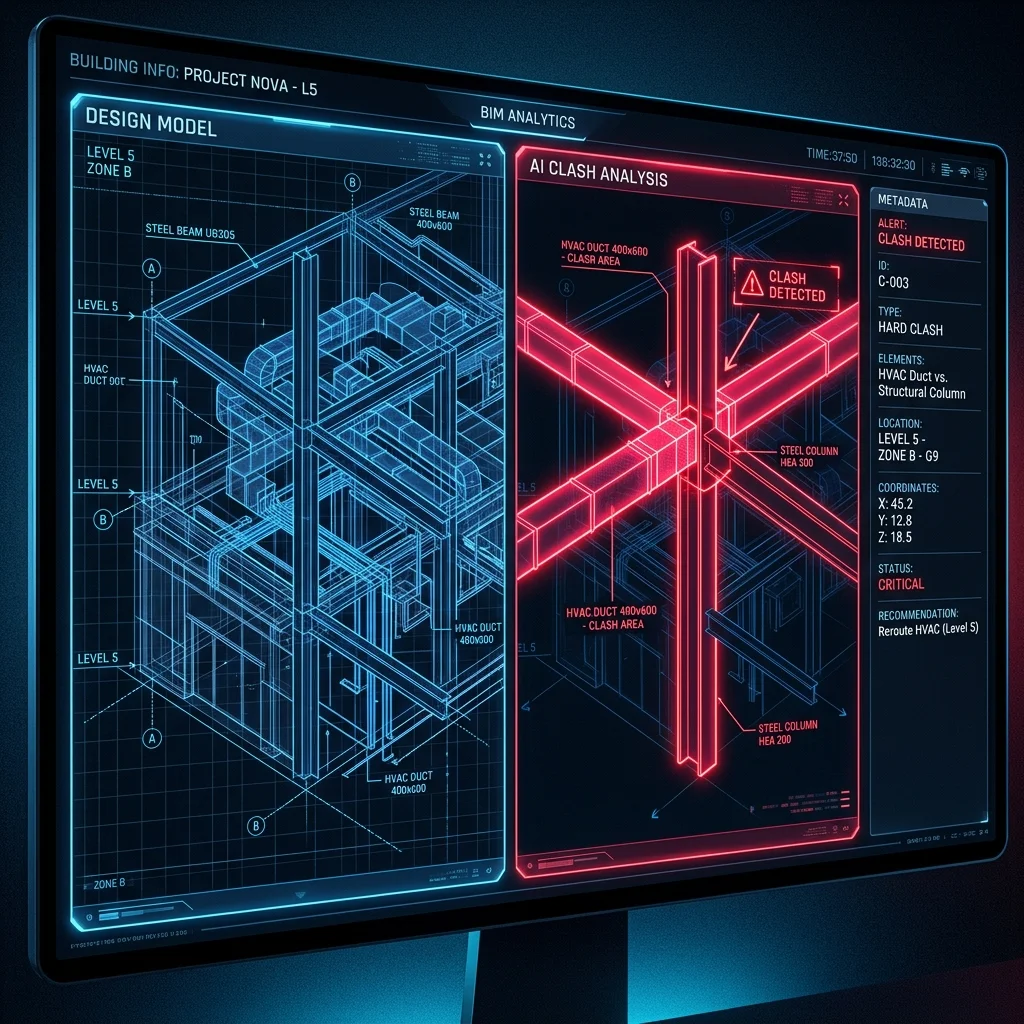
The Core Concept
The system doesn't rely on metadata; it relies on spatial overlap analysis using computer vision. When you feed it a mechanical drawing and an architectural drawing, it performs a three-step process:
- Alignment: It uses OpenCV feature matching to align the structural grid lines of the two different documents.
- Segmentation: It isolates the ductwork (often represented as specific line weights and hatching) on the mechanical plan, and structural beams on the structural plan.
- Clash Detection: It highlights any intersecting bounding boxes that lack a corresponding opening or clearance note.
Using a Vision-Language Model
Where this gets interesting is how the LLM handles the raw vision data. Instead of just flagging a "clash," the system uses a multimodal model (like Claude 3.5 Sonnet or Gemini 1.5 Pro) to read the surrounding text annotations.
If the structural plan says W12x26 (Typ) and the mechanical plan shows an 18" round duct passing through that exact location, the LLM reasons:
"An 18-inch duct cannot pass beneath a W12x26 beam given the current 9-foot ceiling height constraint noted on A-301."
The Impact on Workflows
This tool doesn't replace the architect. It acts as an aggressive quality control layer before drawings are ever issued for construction.
By running this agent overnight against an entire set of construction documents, a design team can wake up to a prioritized list of high-risk conflicts, complete with cropped screenshots of the clash location and reasoning derived from the contract documents.